|


|
|
HYDERABAD TOP TOURIST SPOTS
|
OSMANIA ARTS COLLEGE
|
Being one of the earliest centres of learning in the South is not the sole distinction
of Osmania University. Its eminence is unparalleled in educational architecture
in the country and that attracts as many tourists as its academic facilities attract
students. Five kilometres of drive from the centre of Hyderabad City brings you
through a tree-flanked avenue to a vast pastoral plaza paying tribute to the 2.5
lakh square foot imposing Arts College building, nucleus of Osmania University's
1,500-acre campus, housing a cluster of equally beautiful and impressive buildings
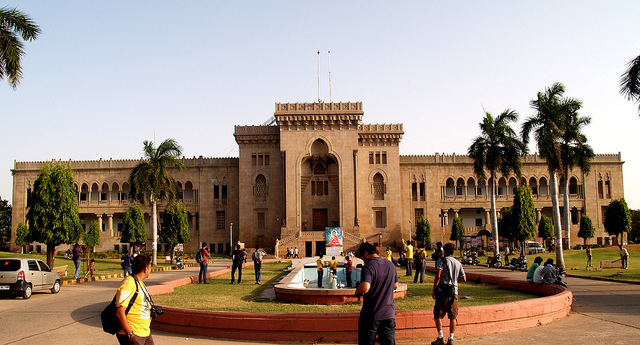
of other faculties.The Arts College edifice is a synonym for architectural uniqueness
unspoilt by the arrival of new fangled architectonics. Overlooking the landscape
gardens is this majestic structure reached by two flights of wide granite stairs
converging and stopping before its awe-inspiring portal that at once is a more eloquent
statement on secularism than any other political manifesto. This stately granite
giant, an articulate specimen of later Osman Shahi architecture, combines the archetypal
characteristics of the Hindu temple styles with those of the Saracenic. Inlaid into
this unique form are motifs of medieval Moslem, Arabic, Moorish and even Gothic
schools of architecture.
The Arts College was originally Osmania University itself and from here starts a
bio-spiritual journey into the world of art and aesthetics revealing itself in sculptured
granite. The visitor is mesmerised by the innards of the great welcome arch built
in dressed granite, seemingly supported by two soaring, round and polished granite
columns. This vertical oblong stands out from the facade and rises higher than the
sidewalls and wings of the structure. It is crowned by a trefoil arch, which peaks
higher than the walls of the edifice to either side of the portal. The arch houses
a semicircular vault with stalactites, resulting in a synthesis of several major
architectural themes of iwan, arch and monumental portal.
According to Dr M. Radhakrishna Sarma, a former professor at Osmania's Department
of Ancient Indian History and Archaeology, “Modelled after the Persian Pishtaq or
the portal found in madarasas and mosques of medieval period, the huge portal is
a triumphal arch that extends a splendid and pressing welcome into a sacred interior."
To the right and left of the great arch are two double-storeyed colonnaded galleries,
each a mirror replica of the other. The entablatures of the first floor are supported
on octagonal pillars typical of columnar architecture found in Ellora and Ajanta
caves. The second floor balconies are arcaded and flaunt trellised balustrades in
a manner similar to the first floor balconies.
Once you leave the frontal arched portal, you step into a magnificent foyer, which
unveils the real wealth of architectural diversity of the Arts College building.
In front of you and beyond the shining, sprawling floor in pink terrazzo is again
another two-pronged stairway presided over by a great window that at one time was
the biggest stained glass window next in size only to the window at Medak church.
The foyer has four internal balconies on its four sides, forming a kind of squarish
halo above the ground floor. These galleries are supported by 24 ornamental pillars,
representative of the best Hindu architectural styles, fluted in parts and crowned
by amalaka capitals.
If you stand in the centre of the foyer and look up, a strikingly grandiose dome
greets you. Islamic in conception and double-decked ie, the dome’s first deck looks
circular to view but has sixteen sides and the second deck, a downward extension
of the first, has sixteen niched windows corresponding to each of the sides of the
first deck. Three flights of banistered stairs, one to the left of the foyer, another
to the right and a third overlooking the foyer lead to the first floor which is
a replica of the ground floor plan with minor departures.
|
|
This floor has four balconies, all with parapets forming a huge square making the
foyer look like a well. “The arcades around the open courtyard, the ornate parapets
of the first floor, all of the same dimensions and of Moorish variety give a mirror
like effect, again a characteristic of medieval Islamic architecture,” says Sharma
who has made a deep study of the Arts College architecture.
Another distinction of the architects and planners of the Arts College building
is that all the pink shade granite stone used to build the great building came from
quarries within the campus area.
Equally beautiful are the Library and Engineering College buildings, less ornate,
less baroque and less complex and yet imposing and striking. The Library building
is built on what is known as Senate Hall hill because originally the architects
planned to build the Senate Hall here.Visitors can take time off from their tour
of granite structures and relax in the aesthetically laid out Landscape Gardens,
which often is rendezvous for adolescent romance.
Next to the three presidency universities and Delhi University, Osmania is the largest
university in the country with ten faculties, 52 departments, 500 plus campus constituent
or affiliated colleges offering courses at all levels ranging from the diploma,
degree to the doctoral and the post-doctoral. It has 1,500 teachers on its rolls
and around three lakh students, 300 among them being foreigners. Osmania started
off as the first university in the country where the teaching medium is not English,
but an Indian language (Urdu). Another distinction of Osmania is its Astronomy department
and more especially of its observatory of international standards which again is
the second largest observatory in the country. |
|
Mir Osman Ali Khan, the last of the Nizams, after whom the university was named,
said at the opening of the Arts College building “God be praised that this gorgeous
edifice is now ready. This structure has no parallel in the world or in India for
beauty, grandeur and nobility. The architectural style of the Arts College is like
the Urdu language, the manifestation of the Hindu and Muslim styles of architecture
and its façade, its pillars and its portals portray the culture an arts of the two
people.” To describe the magnificence of the Arts College is bound to end up as
a treatise on architecture.
The great granite structure, which reveals such architectural extravaganza, conceals
a lot of history of the romance of conceiving, planning and building this elegance
in stone. It was the work of Ali Raza and Zain Yar Jung. Sir Patrick Geddes selected
the present site of the university and soon the two eminent architects of the State
Ali Raza and Zain Yar Jung took off in 1930 on an extensive tour of nearly the entire
world to study the various schools of educational architecture. The tour began at
Madras from where the duo went to Colombo and then to Japan where they visited University
of Osaka and from there sailed to the west of the United states.
For three months, they toured the States studying the architectural styles of older
universities like Princeton, Harvard and Yale and the more recent campuses of California,
Stanford and New York. From America, they journeyed to England where they studied
the architectural niceties of older universities like Oxford, Cambridge, Edinburough
and Manchester and also visited buildings under construction of the universities
of Kingston, Birmingham and Leeds. Their itinerary took them to Europe where they
visited the campuses of Sorbonne, Heidelberg, Munich and Berlin and Austria. They
rounded up their tour with visits to Egypt and Turkey to observe Islamic architectural
styles.
To sum up in Ali Raza’s words: “In the construction of all Osmania buildings, motifs
from different historical periods were borrowed and were made into a harmonious
blending. The pillars were modelled on pillars from Ajanta and Ellora caves. The
arches were modelled on the arches from the monuments at Delhi, Agra and
Charminar
and the Mecca Masjid of Hyderabad. In some places, arches and pillars in the styles
of Arabia have been constructed. In this way, we have purposely ignored the modern
architecture of (Lutyen’s) Delhi.”
In short, the Arts College building is a torrent of architectural glory unleashed
on the spectator, a freeze on history, an epic in granite, and a marvel of a visual
difficult to denote.
|
|
CITY BUSES
|
From:
Secunderabad Railway Station:
Reach Tarnaka in Bus Route No's 90A, 90D, 90D/A, 90L, 90M, 90R, 90U.
Tarnaka
3, 3A, 3C, 3D, 3E, 3K, 3H, 3N,136.
Nampally Railway Station
136, 136B, 136D and 136N.
Mahatma Gandhi Bus Station
3, 3C, 3D, 3E, 3H, 3K,3Y.
Jubilee Bus Station
Reach Sec'bad Railway Station in Bus Route No's 21, 22, 23 and 25.
From Sec'bad board bus route no 90A, 90D, 90D/A, 90L, 90M, 90R and 90U to Tarnaka. From there walkable distance.
|
|
College Timings
|
10.30 a.m. to 5 p.m.
|
|
Telephone
|
2709 8048
|
|
|