|
Andhra Pradesh Tourism
TOP TOURIST SPOTS
MECCA MASJID
|
Mecca masjid is one of the oldest masjids
in the city and easily the biggest. Muhammed Quli
Qutub
Shah began building it in 1617 under the supervision of Mir Faizullah Baig and Rangiah
Choudhary. Mughal emperor Aurangzeb completed the construction in 1694. It took
77 years
to come up as the magnificent edifice we see today. Like many other ancient
buildings in the city, the mosque is a granite giant with awe-inspiring innards.
The main hall of the mosque is 75 feet high, 220 feet wide and 180 feet long, big
enough to accommodate ten thousand worshippers at a time.
Mecca masjid is just a hundred yards
southwest of the historic Charminar. Between Muhammed Quli Qutub Shah and Aurangzeb,
Abul Hasan Tana Shah of Golconda also continued the task launched by the Qutub Shahi
kings. It is believed that Muhammed Quli commissioned bricks to be made from earth
brought from Mecca and inducted them into the construction of the central arch of
the mosque, which explains the name of the mosque.
|
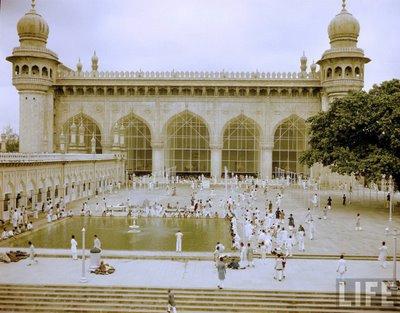
Fifteen graceful arches support the
roof of the main hall, five on each of the three sides. A sheer wall rises on the
fourth side to provide mehrab. The three arched facades have been carved from a
single piece of granite, which took five years to quarry. More than 8,000 masons
and workers were employed to build this grand mosque. Mohammed Quli Qutub Shah himself
laid the foundation stone of the mosque, when he failed to find one person who had
never missed his prayers. The king seemed to be the only person who never missed
on his prayers ever since he was 12 years of age.
“It is about 50 years since they began to build a splendid pagoda in the town which
will be the grandest in all India when it is completed. The size of the stone is
the subject of special accomplishment, and that of a niche, which is its place for
prayer, is an entire rock of such enormous size that they spent five years in quarrying
it, and 500 to 600 men were employed continually on its work. It required still
more time to roll it up on to conveyance by which they brought it to the pagoda;
and they took 1400 oxen to draw it,” says Tavernier in his travelogue.
As the tourist gets past the main gateway and enters a huge plaza, a large man-made
pond of bluish waters greets him. On the edge of the pond are two stone and slab
benches and whoever sits on them, according to legend, returns to sit on them again.
A room in the courtyard is presumed to house the hair of prophet Mohammed. At the
peak of the minarets flanking the masjid is an arched gallery and above that a smallish
dome and a spire. Inscriptions from Quran adorn many of the arches and doors. The
majesty of the façade of the grand mosque is somewhat obscured by huge walls of
wire mesh erected to prevent pigeons from entering the prayer spaces and ruining
them.
|
|
The main structure of the mosque is
sandwiched between two massive octagonal columns hewn out of a single piece of granite.
The cornices running around the entire mosque structure and the floral motifs and
friezes over the arches remind the tourist of the great attention paid to detail
in Qutb Shahi architecture. They have a close resemblance to the ones the tourist
sees on the arches at Charminar and Golconda fort.
Though an overview of the masjid yields
a picture of a massive rectangular granite monolith, closer scrutiny discloses the
sculptural excellence of this axis of Muslim faith and of the parts that constitute
its sum. If the tourist can deflect his gaze from the sheerness of the façade, everything
from the cornices, the alcoves, the balconies to the parapets and the sundry, reveals
an unparalleled aesthetic brilliance. Look at the cornice running on the four sides
of the mosque, you will find 25 windows positioned between the consoles. These windows
have awnings, not very different in their lineage from Hindu temple architecture.
On the four sides of the
roof of the main mosque are ramparts made up of granite planks in the shape of inverted
conches perched on pedestals. From the cornice of the mosque, its minarets are not
as high as the minarets on the mazaar (Nizams’ tombs) haven from their cornice.
The octagonal columns have arched balconies on level with the roof of the mosque
with an awning for a canopy above which the column continues upwards till it is
crowned by a dome and spire.
As the tourist enters the great courtyard
of the mosque, to his left he will find an exquisitely graceful, rectangular, arched
and canopied building housing the marble graves of Asaf Jahi rulers from Nizam Ali
Khan to Mehboob Ali Khan and their family. It is possible that this structure came
up during the rule of the Asaf Jahs because it contains the tombs of the Nizams
and their family. At both ends of this resting place for the Asaf Jahs and very
much a part of it, are two rectangular blocks with four minarets each.
|
|
These minarets have elegant and circular
balconies with low ornamental walls and arches. Above them is an octagonal inverted
platter from which the rest of the minaret soars till it is arrested by a dome and
a spire. This mazaar sanctuary is in reality a far greater specimen of architectural sophistication than the principal masjid and proclaims the artistic penchant of
the Asaf Jahis.
The Mecca masjid is a listed heritage
building crying for constant supervision and maintenance. Stains and patches can
be seen disfiguring the exterior of this majestic structure and cracks are appearing
in the octagonal columns. The mosque received a chemical wash in 1995. The tourist
is also irritated by the growth of foliage in the crevices of the façade.
|
Click Here for Mecca Masjid Map
|
CITY BUSES |
2, 7Z, 8, 8C, 9C |
|
Timings |
6 a.m. to 8 p.m. (Open all days) |
|
Telephone |
2452 4023 |
|
|